
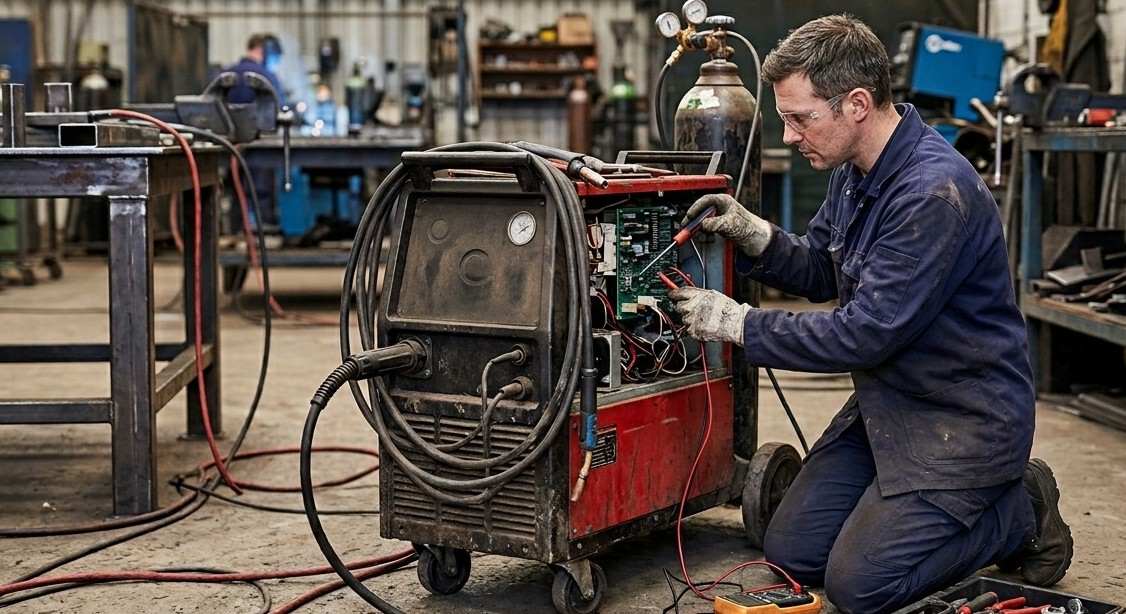
5 Common Welding Machine Faults & How to Prevent Them
Unplanned welding equipment failure is rarely a single cause event. It’s typically the compounding result of thermal stress, electrical wear, and inconsistent maintenance scheduling across a production floor.
For operations leads managing multi shift welding lines, recurring welding machine faults translate directly into missed throughput targets and rising rework costs.
This article breaks down the five most frequent welding machine faults, their underlying technical causes, and the operational controls that prevent them from escalating into costly downtime.
Table of Contents
What Are the Most Common Welding Machine Faults?
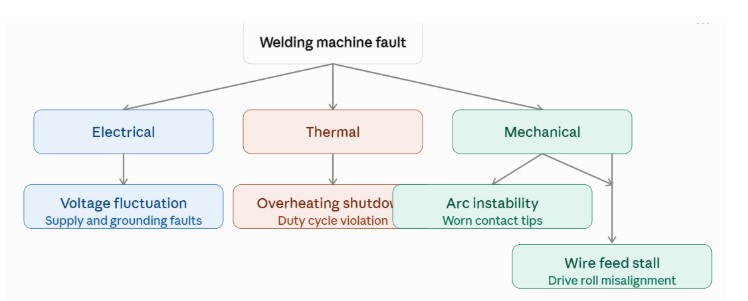
The five most common welding machine faults are inconsistent arc stability, overheating shutdown, wire feed motor malfunction, power supply fluctuation, and ground connection failure. Each fault stems from a distinct root cause, whether thermal, mechanical, or electrical, and requires a targeted inspection protocol rather than a generic fix.
Understanding the failure mode behind each fault is the first step toward building a defensible preventive maintenance schedule rather than reacting to breakdowns after they halt production, as shown in the fault tree above.
Fault 1: Inconsistent Arc Stability
Arc instability occurs when the welding machine cannot maintain a consistent voltage to amperage ratio during operation, producing spatter, porosity, or incomplete fusion. It is most commonly traced to worn contact tips, incorrect polarity settings, or degraded output cables.
Left uncorrected, arc instability creates weld defects that may not surface until post weld inspection or destructive testing, driving up scrap rates on high volume runs.
Prevention checklist:
- Inspect and replace contact tips on a fixed interval, not just on visible wear
- Verify polarity settings against the electrode or wire manufacturer’s specification sheet
- Test output cable continuity monthly using a calibrated multimeter
- Confirm shielding gas flow rate matches the process (MIG, TIG, or flux cored)
Referencing manufacturer output tolerances against AWS D1.1 structural welding code requirements gives quality teams a documented benchmark for acceptable variance, rather than relying on operator judgment alone.
Fault 2: Overheating and Thermal Shutdown
Thermal shutdown happens when internal components exceed their rated operating temperature, triggering the machine’s thermal overload protection to prevent circuit damage. Duty cycle violations, blocked ventilation, and ambient heat buildup in enclosed bays are the primary drivers.
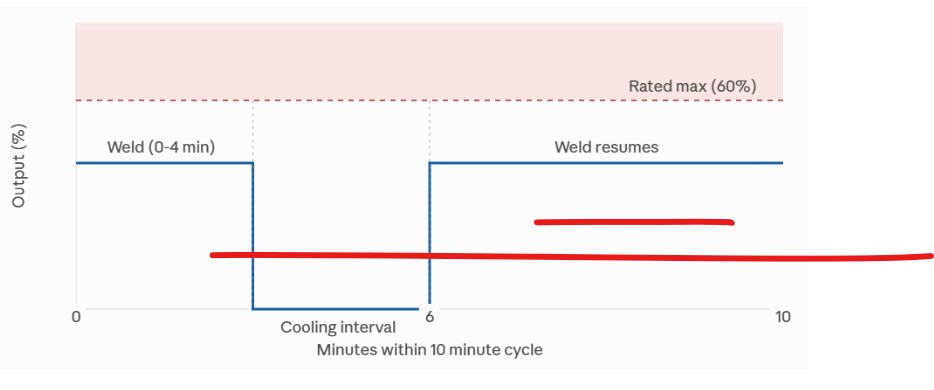
Every welding machine is rated for a specific duty cycle, the percentage of a 10 minute period it can operate at maximum output before requiring a cooling interval. The chart above shows how output must drop to zero during that cooling window. Exceeding the rated threshold repeatedly accelerates insulation breakdown inside the transformer or inverter.
Operational risk parameters to monitor:
- Duty cycle utilization logs against manufacturer rated thresholds
- Ambient bay temperature during peak production shifts
- Airflow clearance around intake and exhaust vents (minimum 12 inches recommended)
- Cooling fan function and dust accumulation on internal heat sinks
Fault 3: Wire Feed Motor Malfunctions
Wire feed motor failure disrupts the consistent delivery of filler wire to the arc, causing burnback, birdnesting, or feed stalling mid weld. It is typically caused by drive roll tension misalignment, liner obstruction, or motor brush wear on older units.
Because wire feed issues often present as intermittent rather than constant faults, they are among the harder failures to diagnose without a structured inspection sequence.
Structured diagnostic sequence:
- Check drive roll tension against wire diameter specification
- Inspect the liner for debris or kinking along its full length
- Test motor voltage output under load
- Confirm spool brake tension prevents wire overrun
Standardizing this sequence into a single page technician checklist reduces average diagnostic time and limits guesswork during high pressure production windows.
If your floor manages this diagnostic process manually across multiple welding cells, reviewing a structured equipment monitoring framework can help centralize fault logs before they escalate into unplanned line stoppages.
Fault 4: Power Supply and Voltage Fluctuations
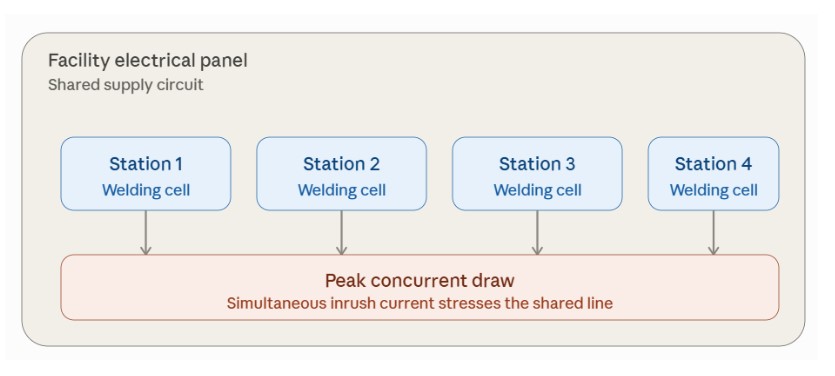
Voltage fluctuation faults occur when incoming line power deviates outside the machine’s tolerance range, causing erratic arc output or automatic shutdown. Facility wide load spikes from other heavy equipment, undersized supply circuits, and worn input connectors are common contributors.
Industrial facilities running multiple welding stations off a shared electrical panel are particularly exposed to this fault category during peak concurrent usage, as the panel diagram above illustrates.
Key prevention parameters:
- Confirm circuit sizing against the machine’s rated input amperage, not just its output rating
- Install line conditioners or voltage stabilizers on facilities with known grid instability
- Stagger high draw equipment start sequences to avoid simultaneous inrush current
- Log voltage readings at the point of connection during peak shift hours
Cross referencing facility power design against NFPA 70 (National Electrical Code) requirements helps operations leads validate that circuit infrastructure, not just the welding machine itself, meets the load profile of the production floor.
Fault 5: Ground Connection Failures
A ground connection failure occurs when the work clamp or grounding path loses continuity, forcing current to seek an alternate, often unsafe, return path. This fault produces erratic arc behavior and represents a direct electrical safety hazard to operators.
Ground faults are frequently misdiagnosed as machine internal problems when the actual cause is corrosion, loose clamp contact, or paint and coating buildup at the workpiece connection point.
Ground integrity checklist:
- Clean the workpiece contact area to bare metal before clamping
- Inspect clamp jaws for corrosion or spring tension loss
- Verify ground cable continuity end to end, not just at the clamp
- Replace any cable showing insulation cracking near strain points
Treating ground connection checks as a pre shift requirement, rather than an occasional inspection item, closes one of the most overlooked gaps in welding safety protocols.
Building a Preventive Maintenance Framework
Reducing the recurrence of these five fault categories requires a documented maintenance cadence rather than reactive repairs. A structured framework assigns inspection frequency, ownership, and escalation thresholds to each fault type.
Proprietary Fault Risk Evaluation Matrix:
| Fault Category | Inspection Frequency | Primary Risk Indicator |
|---|---|---|
| Arc Stability | Weekly | Spatter rate increase |
| Thermal Shutdown | Per shift | Duty cycle log deviation |
| Wire Feed | Weekly | Feed stall frequency |
| Voltage Fluctuation | Monthly | Panel load variance |
| Ground Connection | Pre-shift | Clamp continuity reading |
For facilities managing dozens of welding stations across multiple lines, manually tracking this matrix in spreadsheets becomes a bottleneck of its own. This is where a structured, sensor based monitoring layer typically outperforms manual logs, flagging duty cycle violations or voltage drift before they trigger a full shutdown.
NxTech Nova designs custom, fully managed equipment monitoring systems for manufacturers running high utilization welding fleets, integrating real time fault alerts with existing maintenance workflows rather than replacing them. Explore custom industrial automation solutions to see how a managed monitoring layer fits into an existing production environment.
Before scaling any monitoring investment, it’s worth benchmarking current fault rates using the matrix above for at least one full production cycle. The data will clarify which fault category is driving the majority of your downtime.
Ready to reduce unplanned welding downtime on your production floor? Schedule a technical equipment audit with an engineering team that specializes in custom industrial monitoring builds.
FAQ
What is the most common cause of welding machine failure?
Thermal shutdown from duty cycle violations is among the most frequent causes, as continuous high output welding beyond the machine’s rated cycle accelerates internal component wear and triggers automatic protective shutoffs.
How often should a welding machine be inspected for faults?
Ground connections and duty cycle logs should be checked every shift, while arc stability, wire feed components, and voltage readings warrant weekly to monthly inspection depending on production volume.
Can voltage fluctuations damage a welding machine permanently?
Yes, repeated exposure to voltage outside the rated tolerance range can degrade internal transformer or inverter components over time, shortening the machine’s operational lifespan and increasing unplanned failure risk.
Prevent Welding Downtime & Production Delays
If recurring welding faults are causing downtime, our engineering team can identify failure points and recommend a practical monitoring solution to improve equipment reliability.

Popular Posts
November 8, 2023
November 14, 2023
November 28, 2023
December 4, 2023
December 13, 2023
Copyright © 2024 – Power Blitzz– All rights reserved.