
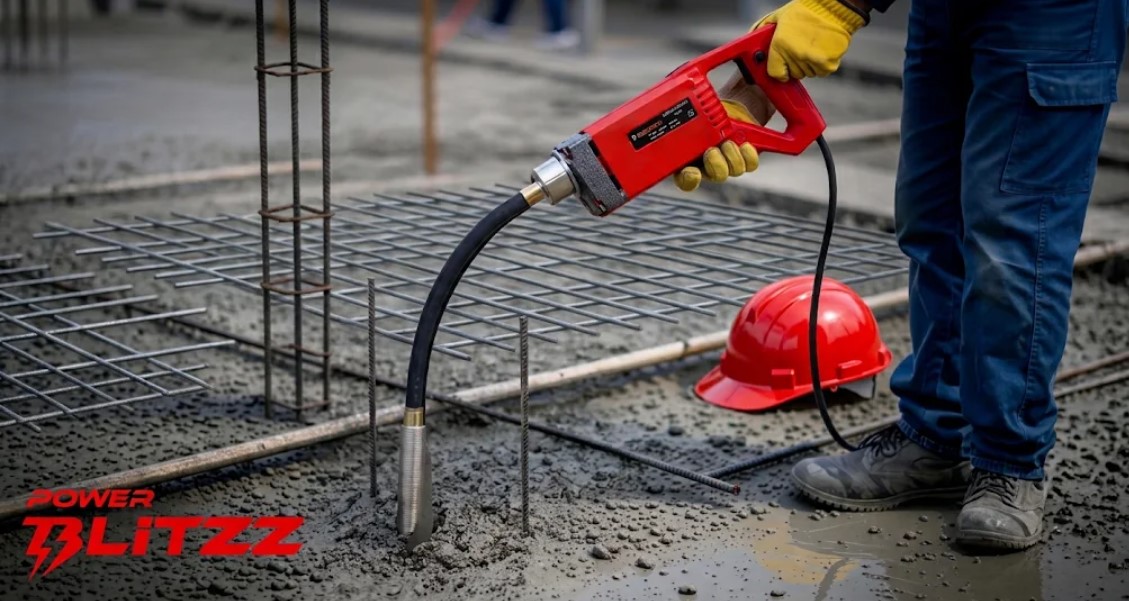
How to Choose a Concrete Vibrator Machine in UAE
Choosing the right concrete vibrator machine in UAE is essential for achieving properly compacted, durable concrete in construction projects. Whether you’re working on a residential foundation, commercial building, concrete slab, or reinforced column, the right equipment helps remove trapped air and reduce honeycombing.
However, not every concrete vibrator is suitable for every project. Motor power, vibrator head diameter, shaft length, vibration frequency, and available power supply all influence performance.
This guide explains how to choose a concrete vibrator machine for construction projects in Dubai, Sharjah, Abu Dhabi, and across the UAE.
What Is a Concrete Vibrator Machine?
A concrete vibrator machine is construction equipment used to consolidate freshly poured concrete by applying rapid vibrations. These vibrations temporarily reduce internal friction in the concrete mixture, allowing it to settle around reinforcement and release trapped air.
Proper concrete vibration helps:
- Remove trapped air pockets from fresh concrete.
- Reduce honeycombing and internal voids.
- Improve concrete contact with reinforcement.
- Achieve more uniform concrete consolidation.
- Improve the quality of finished concrete surfaces.
Concrete vibrators are commonly used for foundations, beams, columns, walls, slabs, and other structural applications.
Looking for the Right Concrete Vibrator Machine?
Explore reliable concrete vibrator machines for different construction requirements. Get expert guidance on choosing suitable equipment for your projects across Dubai, Sharjah, and the UAE.
1. Choose the Right Type of Concrete Vibrator
Before comparing specifications, identify the type of concrete work involved. Different vibration methods are suited to different applications.
Internal Concrete Vibrator
An internal concrete vibrator, also called a poker vibrator or needle vibrator, is inserted directly into freshly poured concrete.
It is commonly used for:
- Reinforced concrete columns and beams.
- Building foundations.
- Concrete walls and footings.
- Slabs with sufficient insertion depth.
Internal vibrators are widely used because they deliver vibration directly into the concrete mixture.
External Concrete Vibrator
External vibrators are attached to formwork or moulds rather than inserted into concrete.
They are useful for precast concrete production, thin sections, and applications where internal access is limited. Formwork must be designed to withstand the applied vibration.
Surface Vibrator
Surface vibrators compact concrete from the surface and are typically used for relatively shallow concrete placements.
They are suitable for certain flooring, paving, and slab applications, depending on the concrete mix and placement thickness.
Which should you choose? For many conventional reinforced concrete applications, an internal concrete vibrator is a practical option. However, the correct type depends on section dimensions, reinforcement spacing, and the concrete mixture.
2. Check the Motor Power and Voltage
Motor power is an important specification when choosing an electric concrete vibrator. It influences the equipment’s ability to drive a compatible vibrating shaft and operate under load.
Power Blitzz offers models with different motor capacities, including:
| Concrete Vibrator Model | Motor Power | Voltage |
|---|---|---|
| BT-VB850 | 850W | 220–240V |
| BT-ZN90/1 | 2.2kW | 220–240V |
| BT-ZN90/3 | 2.2kW | 380V |
A compact handheld vibrator may be convenient for smaller or occasional jobs, while a compatible higher-powered drive unit may be preferable for demanding work requiring longer shafts or continuous operation.
However, higher wattage does not automatically mean better concrete compaction. Performance also depends on the vibrating head, amplitude, frequency, shaft compatibility, and concrete consistency.
Before purchasing, confirm the voltage, rated current, electrical connection, and power supply available at your UAE construction site.
3. Select the Correct Vibrator Head Diameter
The vibrator head diameter determines whether the equipment can move freely through reinforcement and influences the surrounding area that can be consolidated.
Typical application ranges include:
| Head Diameter | Common Applications |
|---|---|
| 20–40 mm | Thin sections and congested reinforcement |
| 30–65 mm | Walls, beams, columns, and general construction |
| 50–90 mm | Larger sections with adequate reinforcement clearance |
| 75 mm and above | Mass concrete and open, heavy-duty placements |
These ranges are general guidance rather than fixed requirements. Actual selection depends on aggregate size, concrete workability, reinforcement spacing, and the manufacturer’s specifications.
For reinforced concrete, choose the largest suitable head that can move freely through the reinforcement without becoming trapped or damaging the formwork.
Buyer tip: Before choosing a concrete vibrator shaft, measure the available clearance between reinforcement bars and verify the head dimensions.
4. Consider Vibrator Shaft Length and Accessibility
The concrete vibrator shaft connects the driving equipment to the vibrating head in flexible-shaft systems.
Selecting the correct shaft length is especially important for deep foundations, columns, and areas with restricted access.
A short shaft may be easier to handle for shallow placements, while deeper pours may require a longer shaft to reach the full placement depth.
When comparing concrete vibrator shafts, consider:
- Depth of the concrete placement.
- Distance between the power unit and insertion point.
- Flexibility and ease of movement.
- Shaft diameter and coupling compatibility.
- Manufacturer-approved shaft length.
Always verify compatibility with the selected motor. An excessively long or incompatible shaft may affect transmission performance and equipment reliability.
5. Understand Vibration Frequency and Speed
Vibration frequency describes how many vibration cycles the head produces per second or minute. It is typically expressed as hertz (Hz) or vibrations per minute (VPM). Frequency and amplitude work together to determine how effectively a vibrator consolidates concrete.
Many internal concrete vibrator applications use operating frequencies in approximately the 7,800–15,000 VPM range, although suitable values depend on the head diameter, concrete mixture, and equipment design.
Important: Motor RPM and vibrator-head VPM are not necessarily the same measurement.
For example, the Power Blitzz BT-ZN90/1 has a listed no-load motor speed of 2,840 RPM. This figure should not be interpreted as its vibrating-head frequency.
When comparing models, check the manufacturer’s actual vibrator-head performance specifications rather than relying on motor speed alone.
6. Consider UAE Construction Site Conditions
Construction sites in Dubai, Sharjah, Abu Dhabi, and other UAE locations may expose equipment to high temperatures, airborne dust, and demanding operating schedules. These conditions make equipment selection and maintenance particularly important.
Before buying a concrete vibration machine, check the following:
Heat management: Choose equipment suitable for the manufacturer’s specified ambient temperature and operating duty. Keep ventilation openings clear and avoid unnecessary exposure to direct sunlight.
Dust protection: Inspect motor housings, ventilation systems, and electrical connections regularly. Follow the manufacturer’s recommended cleaning procedures.
Electrical safety: Verify site voltage, suitable connectors, protective devices, and cable condition. Use appropriate electrical protection in wet concrete environments.
Maintenance access: Consider whether replacement shafts, couplings, and other service parts can be obtained when needed.
For UAE contractors, equipment reliability is influenced not only by initial specifications but also by correct usage and routine maintenance.
7. Compare Concrete Vibrator Models from Power Blitzz
Power Blitzz offers different electric concrete vibrators for construction applications.
Concrete Vibrator BT-VB850
The BT-VB850 Concrete Vibrator is an 850W electric model with a listed 35 mm × 1.5 m shaft assembly.
Its compact configuration makes it worth considering for applications where portability and manageable shaft length are important.
Key specifications:
- Input power: 850W
- Voltage: 220–240V
- Frequency: 50/60Hz
- No-load motor speed: 4,000 RPM
- Listed shaft size: 35 mm × 1.5 m
Electrical Concrete Vibrator BT-ZN90/1
The BT-ZN90/1 Electrical Concrete Vibrator features a 2.2kW motor and a 220–240V electrical configuration.
It is an option for contractors seeking a higher-powered vibrator drive unit compatible with their intended shaft and vibrating-head setup.
Key specifications:
- Input power: 2.2kW
- Voltage: 220–240V
- No-load motor speed: 2,840 RPM
- Rated current: 13.5A
Electrical Concrete Vibrator BT-ZN90/3
The BT-ZN90/3 Electrical Concrete Vibrator is another 2.2kW model, designed for a 380V power supply.
It may be appropriate for construction sites equipped with a compatible industrial electrical supply.
Key specifications:
- Input power: 2.2kW
- Voltage: 380V
- No-load motor speed: 2,840 RPM
- Rated current: 4.7A
Before ordering, confirm the required shaft and head assembly, connection type, operating duty, and electrical compatibility.
8. Avoid Common Concrete Vibration Mistakes
Even the right machine can produce poor results when used incorrectly.
Common mistakes include:
- Using an oversized head: A large vibrator may not fit through congested reinforcement.
- Insufficient vibration: Inadequate consolidation can leave trapped air, voids, and honeycombing.
- Excessive vibration: Over-vibration can contribute to segregation, particularly in susceptible concrete mixtures.
- Incorrect insertion spacing: Large gaps between insertion points may leave sections inadequately compacted.
- Using vibration to move concrete sideways: Vibrators are designed for consolidation, not for transporting concrete through formwork.
For effective results, insert the vibrator approximately vertically, allow adjacent areas of influence to overlap, and withdraw it gradually.
The vibrator should penetrate slightly into the previous layer when consolidating successive fresh layers, where practical. Stop when the concrete has settled adequately and large air bubbles are no longer rising.
Always follow the approved method statement, project specifications, and equipment manufacturer’s operating instructions.
9. What to Check Before Buying a Concrete Vibrator in UAE
Use this checklist before selecting a machine:
- Identify the concrete element and placement depth.
- Check reinforcement spacing and aggregate size.
- Select a compatible vibrator head diameter.
- Confirm the motor power and rated voltage.
- Verify the shaft length and coupling type.
- Review vibrating-head frequency and performance.
- Check operating duty and maintenance requirements.
- Confirm accessories, replacement parts, and supplier support.
A suitable concrete vibrator should match the project requirements rather than simply have the highest motor rating.
FAQs
What size concrete vibrator is best for construction?
The correct size depends on the structure, reinforcement spacing, concrete workability, and placement depth. Smaller heads are useful in confined spaces, while larger heads can consolidate wider areas where sufficient clearance is available.
Can a concrete vibrator be used for columns and foundations?
Yes. Internal concrete vibrators are commonly used for reinforced concrete columns, foundations, beams, and walls. The head must be able to reach the required depth and pass safely between reinforcement bars.
How long should concrete be vibrated?
The required time varies with concrete workability, layer thickness, equipment performance, and vibration intensity. Operators should observe concrete settlement, escaping air, and surface appearance rather than rely on a fixed number of seconds for every pour.
Find the Right Concrete Vibrator Machine
Choosing the right concrete vibrator machine helps contractors achieve consistent consolidation, reduce avoidable defects, and maintain efficient concrete placement.
Before purchasing, compare the head diameter, shaft length, motor specifications, site power supply, and type of construction work.
Looking for a Concrete Vibrator Machine in UAE?
Contact Power Blitzz for assistance with model selection, shaft compatibility, and product enquiries. Get expert support for your construction equipment requirements in Dubai, Sharjah, and across the UAE.

Popular Posts
November 8, 2023
November 14, 2023
November 28, 2023
December 4, 2023
December 13, 2023
Copyright © 2024 – Power Blitzz– All rights reserved.