
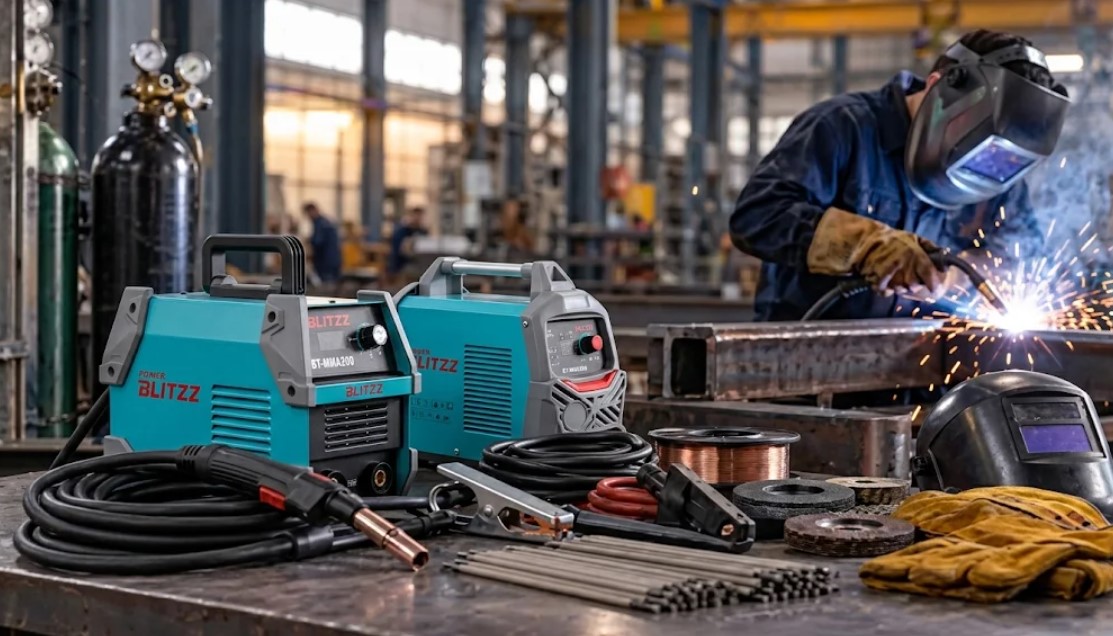
How to Choose the Right Welding Machine for Your Workshop
A welding machine is one of the biggest equipment decisions in a metalworking shop, and one of the easiest to get wrong. Choosing an undersized machine can cause overheating and interruptions during work, while an oversized machine may increase equipment and power infrastructure costs without providing any practical benefit.
Compact inverter technology, multi-process units, and digital controls have made spec sheets harder to compare. This guide shows you how to choose a welding machine for your workshop with five measurable checks: material, thickness, duty cycle, power supply, and operator skill.
It is written for workshop owners, fabrication leads, and maintenance managers who need a decision framework, not a brand list.
What Is the Best Welding Machine for a Workshop?
The best welding machine for a workshop is the one that matches your base material, typical joint thickness, daily arc-on time, available power supply, and operator skill.
No single model wins in every shop, because a repair garage and a fabrication line stress equipment in completely different ways. Scoring these five factors first removes guesswork and prevents costly over- or under-specification.
We call this the 5-Point Workshop Match. Score each factor before you compare brands or prices.
- Material: mild steel, stainless steel, aluminium, or a mix.
- Thickness: the thickest joint you weld every week, not once a year.
- Duty cycle: your realistic arc-on minutes per hour.
- Power supply: 230 V single-phase or 400 V three-phase, plus breaker and cable limits.
- Skill level: who operates the machine, and how often operators change.
Which Welding Process Should You Choose: MIG, TIG, or MMA?
Choose MIG for speed and general fabrication, TIG for precision on thin stainless steel or aluminium, and MMA (stick) for thick, dirty, or outdoor work.
Each process differs in arc type, consumables, and shielding method, so the wrong choice shows up as porosity, slow output, or rework. Your material and joint quality requirements decide the winner, not the price tag.
| Process | Best For | Shielding | Skill | Main Limitation |
|---|---|---|---|---|
| MIG (GMAW) | Mild steel, production, general fabrication | External gas (argon or argon/CO2 mix) | Low to medium | Gas disperses in drafts; less tolerant of rust |
| TIG (GTAW) | Thin sheet, stainless steel, aluminium, root passes | Pure argon | High | Slow; needs very clean surfaces |
| MMA (SMAW) | Thick steel, repair, site work | Flux coating on electrode | Medium | Slag removal; poor on thin sheet |
What Is MIG Welding Best For?
MIG welding (GMAW) feeds a continuous wire electrode through a torch while shielding gas protects the weld pool. It suits mild steel, stainless steel, and aluminium at high travel speeds, and it delivers the best balance of productivity and learning curve for most general fabrication shops.
Watch for drafts. Open doors and workshop fans can blow shielding gas away from the pool and cause porosity. Aluminium also needs a spool gun or push-pull torch, because soft wire tangles in a standard liner.
When Does TIG Welding Make Sense?
TIG welding (GTAW) uses a non-consumable tungsten electrode and a separate filler rod, which gives the cleanest and most controlled weld. Choose it for thin stainless steel, aluminium, and visible or pressure-critical joints, but expect slower travel speeds and higher operator skill requirements than MIG or MMA.
Aluminium requires an AC output. A DC-only TIG unit handles steel and stainless steel but not aluminium. Pulse control and lift-arc or high-frequency starts improve thin-sheet results and protect the tungsten.
Is MMA (Stick) Welding Still Relevant?
Yes, MMA welding (SMAW) remains relevant because it needs no external shielding gas, tolerates rust and wind, and runs on simple, rugged equipment. It suits structural repair, thick plate, and site work, though you must accept slag removal and weaker finish quality on thin sheets.
Electrode choice matters. E6013 handles general-purpose work, while low-hydrogen E7018 suits structural joints but must be stored dry. Budget for a rod oven or sealed tubes.
Is a Multi-Process Welding Machine Worth It?
A multi-process welding machine is worth it when your workshop switches between MIG, TIG, and MMA jobs during the week but rarely runs more than one operator at a time. It saves floor space and capital compared with buying three dedicated units.
It is a weaker choice if two welders must work simultaneously on different processes. The trade-off is peak performance. A dedicated TIG unit usually offers finer control than a combination unit’s TIG mode, and one fault takes every process offline.
What Does Duty Cycle Mean on a Welding Machine?
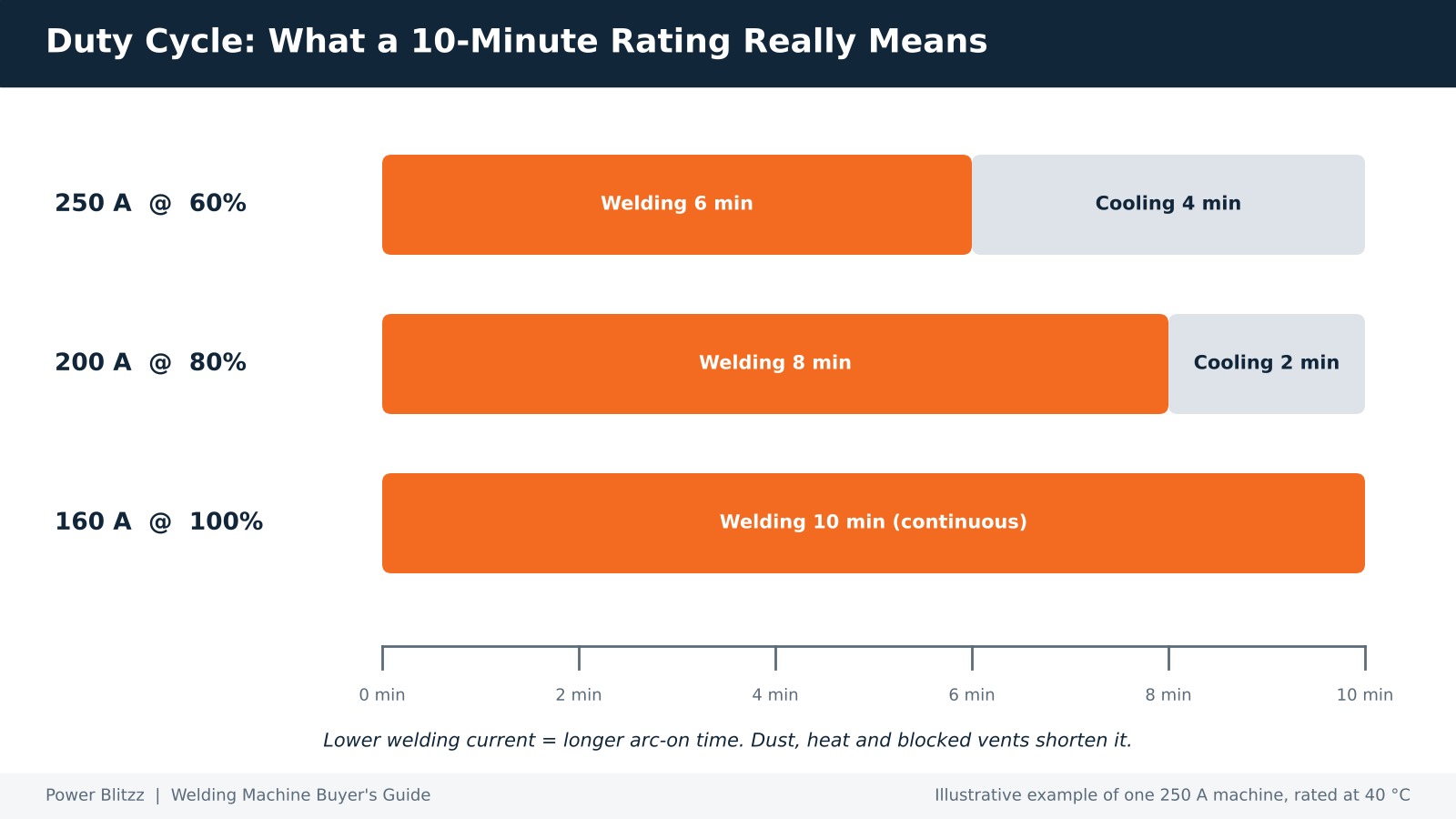
Duty cycle is the percentage of a 10-minute period that a welding machine can run at its rated current without overheating. A 60% duty cycle at 250 A means six minutes of welding and four minutes of cooling, and standard ratings are measured at 40°C under IEC 60974-1.
Duty cycle rises as current falls. The same unit might offer 100% at a much lower amperage, so always compare ratings at your actual working current.
Real conditions reduce it further. High ambient temperatures, dust-clogged vents, and long cable runs push the machine toward thermal shutdown. A shop welding 40 minutes per hour has an arc-on ratio of about 67%, so a machine rated 60% at your working current will be marginal.
How Many Amps Does a Workshop Welding Machine Need?
Most workshops need 160 to 250 A for mild steel up to 6 mm, and 300 A or more for regular heavy plate. A practical rule is roughly 35 to 40 A per millimetre of steel thickness for a single pass. Always buy headroom above your thickest regular joint.
- 1 to 3 mm: 100 to 160 A
- 3 to 6 mm: 160 to 250 A
- 6 to 12 mm: 250 to 400 A with multi-pass welding
Treat these as planning ranges. Joint preparation, wire diameter, and your welding procedure specification decide the final settings.
Matching specs to your own numbers? Compare amperage, duty cycle, and input voltage across our range of industrial welding machines before you shortlist.
Single-Phase or Three-Phase Welding Machine?
Single-phase 230 V suits most welding machines up to roughly 200 to 250 A, while three-phase 400 V is the better choice for heavier, continuous production work. Three-phase draws current more evenly across conductors and supports higher duty cycles at heavy loads. Check your breaker rating, cable size, and generator capacity before you order.
Look at input voltage tolerance. A wide range, such as plus or minus 15%, protects the inverter when you run from a generator or a weak supply. Power factor correction (PFC) also lowers current draw, which helps on circuits near their limit.
Inverter or Transformer Welding Machine: Which Is Better?
Inverter welding machines are better for most workshops because they are lighter, more energy efficient, and offer smoother arc control with features such as pulse and adjustable arc force. Transformer machines are heavier but rugged, and simpler to repair in the field.
Choose an inverter unless you work in extremely harsh conditions with limited access to electronic repair support. Inverters rely on IGBT power electronics and control boards. Check the protection class, such as IP23S, plus surge protection and fan-on-demand cooling, to limit dust ingress and voltage damage.
What Safety Standards and Hidden Costs Should You Check?
Confirm that the welding machine complies with IEC 60974-1 for arc welding equipment, carries CE marking, and states a protection class such as IP23S. Then budget for consumables, shielding gas, personal protective equipment, fume extraction, and warranty-backed servicing, because purchase price is only one part of ownership cost.
For safe practice and process fundamentals, the American Welding Society publishes widely used references, including the Z49.1 safety standard. OSHA guidance on welding fumes and ventilation is another core reference.
- Consumables: contact tips, nozzles, liners, tungsten, and electrodes.
- Shielding gas: cylinder rental, refills, and regulators.
- PPE: auto-darkening helmet, gloves, and flame-resistant clothing.
- Ventilation: fume extraction and local exhaust.
- Support: warranty terms, spare parts, and technical assistance.
Need Help Choosing the Right Welding Machine?
Ask Power Blitzz about warranty terms, spare-part availability, and technical support before making your purchase. Get guidance to make a confident equipment investment.
Which Welding Machine Suits Your Workshop Type?
Maintenance shops suit a 200 to 250 A multi-process inverter, general fabrication suits a 250 to 350 A MIG machine, and stainless or aluminium shops need an AC/DC TIG unit.
Heavy structural and plate work calls for 400 A three-phase equipment with a high duty cycle. The table below maps each workshop type to the spec you should verify.
| Workshop Type | Typical Work | Suggested Setup | Spec to Verify |
|---|---|---|---|
| Maintenance and Repair | Mixed repairs, rusty parts, site calls | 200 to 250 A multi-process inverter | Input voltage range, portability |
| General Fabrication | Mild steel frames, gates, structures | 250 to 350 A MIG, often three-phase | Duty cycle of 60% or more at working current |
| Stainless and Aluminium | Tanks, food equipment, thin sheet | 200 to 300 A AC/DC TIG with pulse | AC balance, pulse, cooling |
| Heavy Structural | Beams, thick plate, site erection | 400 A three-phase MIG or MMA | Duty cycle, cable size, electrode storage |
What Should You Check Before You Buy?
Before you buy, list your three most common materials, your thickest regular joint, and your weekly arc-on hours. Then confirm the power supply and breaker rating, choose the welding process, and compare the duty cycle at your actual working current. Finish by verifying the standard, protection class, consumables, and warranty.
- List your top three materials and your thickest regular joint.
- Calculate your arc-on minutes per hour.
- Confirm supply voltage, phase, breaker, and cable size.
- Select the process using the flowchart above.
- Compare duty cycle at your working current, not the maximum.
- Verify IEC 60974-1, protection class, consumables, and warranty.
Final Verdict
Yes, for any workshop that welds regularly or runs production jobs, a correctly specified welding machine is worth the investment. It reduces rework, downtime, and consumable waste, keeps weld quality consistent as operators change, and protects inverter electronics from overload and overheating.
Intent matters. Occasional repair users can choose a compact single-phase inverter. Production and fabrication shops should prioritise duty cycle, three-phase supply, and serviceability over headline amperage.
Ready to Match a Welding Machine to Your Workshop?
Contact the Power Blitzz team for technical guidance on welding machine selection, from choosing the right welding process to planning your power supply. Get expert support in Sharjah, Dubai, and across the UAE.
FAQs
What size welding machine do I need for a small workshop?
A 200 A inverter MIG or multi-process welding machine on single-phase 230 V covers most small workshops, handling sheet and plate up to about 6 mm with multi-pass technique. Confirm the duty cycle at your working current and your breaker rating before you buy.
Is MIG or TIG better for a workshop?
MIG is better for speed, general fabrication, and easier operator training, while TIG is better for thin stainless steel, aluminium, and visually critical joints. Most workshops start with MIG or a multi-process inverter and add dedicated TIG capacity when precision work grows.
How do I know if a welding machine’s duty cycle is enough?
Compare the rated duty cycle at your actual working current with your arc-on time per 10 minutes. If you weld six minutes in every ten at 250 A, you need at least 60% at 250 A, plus margin for heat and dust.

Popular Posts
November 8, 2023
November 14, 2023
November 28, 2023
December 4, 2023
December 13, 2023
Copyright © 2024 – Power Blitzz– All rights reserved.