
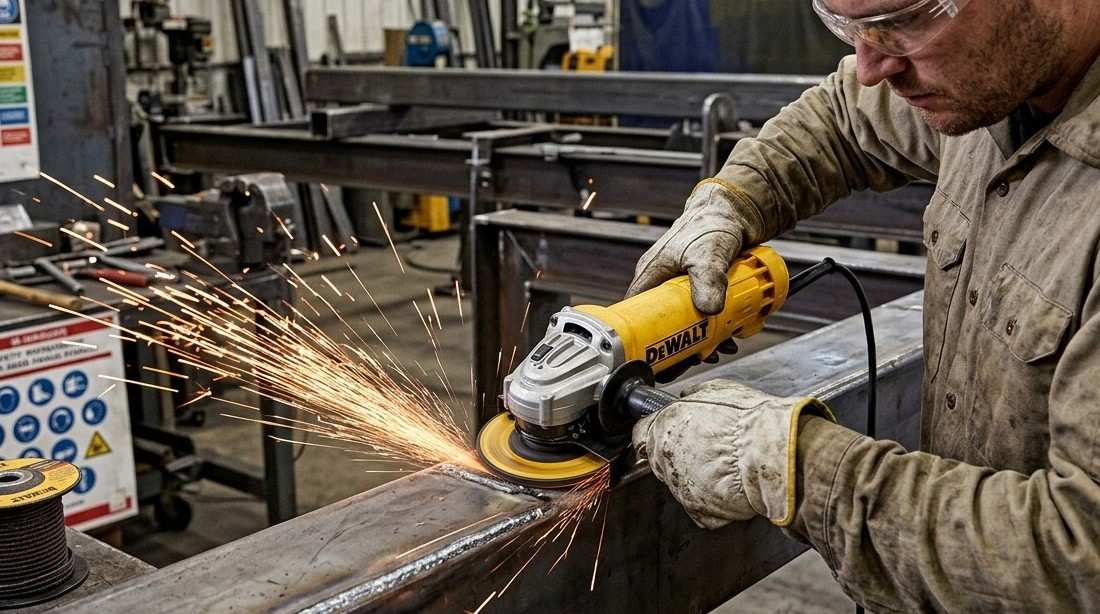
Angle Grinder Buying Guide: How to Choose the Right One
An angle grinder is one of the most versatile power tools you can own. It cuts metal, grinds welds, polishes surfaces and strips paint or rust, all with a single handheld body. With so many disc sizes, power ratings and safety features on the market, picking the right model can feel confusing.
This guide breaks down every factor that matters, disc size, wattage, power source and safety, so you can choose a grinder that matches your project instead of guessing at the spec sheet.
What Is an Angle Grinder Used For
An angle grinder is a handheld tool with a spinning disc mounted at a right angle to the motor. Depending on the disc fitted, it can cut steel, grind down welds, sharpen blades, remove rust and paint, or polish stone and metal surfaces. It is used across construction sites, metal fabrication shops, car repair bays and home garages.
Because a single grinder body handles so many different discs, understanding its core applications helps you decide which specifications matter for your work. For real world examples, see our guide on common angle grinder applications.
Disc Size Is the First Spec to Check
Disc size determines how deep a grinder can cut and how much material it can remove in a single pass. The most common sizes are 100mm 115mm 125mm 180mm and 230mm. Smaller discs spin faster and are easier to control with one hand, while larger discs cut deeper but need two hand operation.
| Disc Size | Typical RPM | Best For |
|---|---|---|
| 100 mm to 115 mm | 10,000 to 11,000 | Light DIY tasks, tile trimming, and tight spaces |
| 125 mm | 10,000 to 11,000 | Regular small-scale cutting and grinding |
| 180 mm | 8,000 to 9,000 | Medium-duty fabrication work |
| 230 mm | 6,000 to 6,600 | Heavy-duty concrete and masonry cutting |
Always confirm the disc diameter your specific grinder model accepts before buying replacement discs, since a mismatched disc is both unsafe and often physically impossible to fit.
Wattage and Motor Power Explained
Wattage tells you how much force the motor delivers under load. Angle grinders range from around 500W for light household models up to 2500W for professional tools. Higher wattage cuts through thick steel and runs continuously without straining, while lower wattage suits occasional grinding and sanding.
Do not confuse wattage with RPM. Wattage measures raw power output, while RPM measures disc speed. A grinder can spin fast yet have only moderate wattage, which limits how well it cuts dense material. For prolonged use, such as cutting metal sheets for hours, prioritize a higher wattage model. For more on how wattage relates to pricing across grinder classes, see our heavy duty grinder machine price guide.
Corded vs Cordless Angle Grinders
Once disc size and wattage are settled, the next decision is power source.
- Corded grinders deliver constant uninterrupted power and work well for workshop use or long cutting sessions near a socket.
- Cordless grinders run on rechargeable lithium ion batteries, usually 18V or 20V, and offer freedom of movement with no trailing cable to manage.
- Cordless models suit ladders roofs and spread out job sites where mobility matters more than unlimited runtime.
- Corded models are typically lighter and more affordable for the same power output.
If portability and reduced setup time are priorities, a cordless grinder is worth the investment. If you regularly work in one spot for extended sessions, a corded model remains the more practical choice.
Matching the Disc to the Job
The grinder itself is only half the equation. The disc fitted determines what the tool can safely and effectively do.
- Cutting discs are built for fast straight cuts through metal tile stone or masonry.
- Grinding discs are used for smoothing welds shaping edges and removing material.
- Flap discs handle surface finishing paint removal and general polishing.
- Wire brush wheels strip rust and old paint from metal surfaces.
- Diamond blades cut hard masonry materials such as concrete granite and brick.
Using the wrong disc for a material is a genuine safety hazard, since a disc rated for metal can shatter unpredictably on stone or ceramic. Always check the disc label matches the material before switching the tool on. If you are still unsure how an angle grinder compares to other grinding tools in your workshop, our comparison of the bench grinder versus angle grinder explains the key differences.
Safety Features to Look For
Angle grinder discs commonly spin between 8000 and 11000 RPM, so safety features are not optional extras, they are core to the tool. This is one reason the angle grinder is considered such a versatile workshop tool, it can handle heavy jobs safely when the right features are in place.
| Safety Feature | What It Does |
|---|---|
| Protective Guard | Shields the user from sparks and disc contact |
| Anti-Kickback Protection | Reduces sudden jerking if the disc binds |
| Slow-Start Motor | Prevents a sudden jolt of torque at startup |
| Paddle or Kill Switch | Cuts power instantly if the tool is dropped |
| Spindle Lock | Holds the spindle steady for quick disc changes |
| Restart Protection | Stops the tool restarting after a power cut |
Beyond the tool’s built in features, always wear gloves eye protection and a dust mask, and operate the grinder with both hands whenever the model allows it. For a complete walkthrough of safe operating habits, read our guide on angle grinder safety precautions.
If this is your first time using one at home, our article on using an angle grinder safely for home projects is a helpful starting point before you get to work.
Which Angle Grinder Should You Buy
Bringing all the factors together makes the decision much simpler.
- Light DIY or occasional home use calls for a smaller disc size, moderate wattage and a corded model to keep costs down.
- Frequent workshop or professional use calls for higher wattage, a larger disc for deeper cuts and a cordless model if you move between job sites often.
- Anyone cutting dense metal or masonry for extended periods should prioritize wattage and a full set of safety features over price alone.
Once you are confident with safe handling, you can explore smart uses of an angle grinder in DIY and construction to get more value out of the tool you choose.
Matching these four factors, disc size, wattage, power source and safety, to your actual workload is the single best way to avoid buying a grinder that is either underpowered or more machine than you need. Once you know the specification that fits your project, you can browse angle grinder machines in UAE built for both home and professional use.
Conclusion
Choosing the right angle grinder comes down to matching disc size and wattage to your workload, picking a power source that fits how you work, and never compromising on safety features.
Looking for a trusted power tools supplier in the UAE? Power Blitzz offers a reliable range of angle grinders built for efficient long term performance. Contact Power Blitzz today to get expert guidance on choosing the right tool for your needs.
Keep Reading More Guides
- How to Choose the Right Submersible Water Pump: Learn how to size and select a submersible pump correctly.
- Complete Guide to Air Compressor Maintenance Tips: Simple upkeep habits that keep motors running efficiently.
- How to Choose Energy-Efficient Power Tools for Sustainable Construction in Abu Dhabi: See how smarter equipment choices lower long term power costs.
- Industrial vs Commercial Generators: What’s the Difference?: Compare backup power options for continuous pump operation.
- Complete Guide to Choosing Reliable Petrol Generator Suppliers in UAE: Find dependable backup power sources for your pump systems.

Popular Posts
November 8, 2023
November 14, 2023
November 28, 2023
December 4, 2023
December 13, 2023
Copyright © 2024 – Power Blitzz– All rights reserved.