
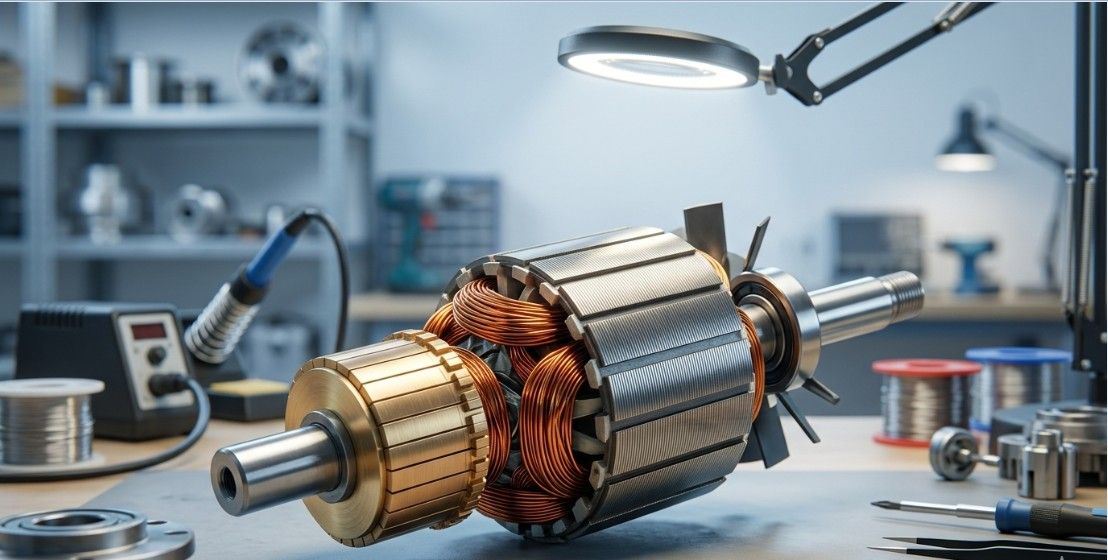
Power Tool Armature Fault Detection: Complete Guide
The armature is the heart of most brushed power tools such as grinders, drills, circular saws, and polishers. It converts electrical energy into rotational motion through electromagnetic interaction with field windings and carbon brushes. When the armature begins to fail, tool performance drops quickly, often showing early warning signs before complete breakdown.
Industry repair data shows that a large percentage of universal motor failures in handheld tools are directly related to armature issues such as winding shorts, commutator damage, and insulation breakdown. Technicians consistently report that early detection can reduce full motor replacement costs and extend tool lifespan significantly.
Understanding the Role of the Armature
The armature is a rotating electrical component consisting of copper windings, a laminated iron core, and a segmented commutator. For high-performance replacements and reliable upgrades, professionals often choose quality power tools armature designed for durability under heavy load.
Core functions include:
- Producing torque through electromagnetic interaction
- Carrying current through rotating windings
- Maintaining stable rotation under load
- Working with brushes to complete the electrical circuit
Any defect in this system directly impacts speed, torque, and safety of the tool.
Common Causes of Armature Failure
Armature failure usually happens due to long-term wear or improper usage. Some common reasons include:
- Excessive heat buildup during heavy use
- Overloading the tool beyond its capacity
- Dust and debris entering the motor housing
- Worn carbon brushes causing uneven contact
- Electrical surges or unstable power supply
- Lack of maintenance and cleaning
Understanding these causes helps prevent future damage and improves tool lifespan.
Visible and Physical Signs of Armature Failure
Burning smell or smoke
A strong burning odor or visible smoke usually indicates insulation failure or overheating inside the windings.
Heavy sparking at brushes
Excessive sparks around carbon brushes often point to a damaged commutator or shorted armature windings.
Darkened or burnt windings
Copper coils appear dark, blackened, or discolored due to overheating and electrical stress.
Melted solder
Solder joints connecting windings to commutator segments may melt or loosen under extreme heat.
Worn commutator
The copper segments where brushes contact become heavily worn, scored, uneven, or in severe cases, missing small sections. This leads to unstable current flow and poor performance.
Operational Symptoms in Power Tools
- Loss of torque: Tool struggles under load and may stall during cutting or grinding.
- Irregular speed: Motor speed fluctuates or becomes jerky due to uneven coil resistance.
- Excessive vibration: Electrical imbalance in the armature creates mechanical vibration.
- Overheating housing: The tool body becomes unusually hot within minutes of operation.
Testing Methods for Identifying a Faulty Armature
Visual Inspection (Commutator and Windings)
Overview
Visual inspection is the first step in diagnosing armature issues. It helps identify physical damage caused by overheating, electrical faults, or mechanical wear before performing advanced testing.
What to look for
- Debris between commutator bars
- Burnt or damaged insulation on windings
- Discoloration of copper windings
- Loose connections or solder damage
Key interpretation
- Visible burning or contamination indicates internal electrical or thermal damage
- Uneven discoloration suggests overheating or poor brush contact
- Severe physical damage often confirms deeper internal faults
Multimeter Resistance Test (Bar-to-Bar Test)
Overview
This test is used to detect internal winding faults such as shorted or open coils. It is one of the most accurate basic electrical tests for armature diagnosis.
Procedure
- Set multimeter to ohms (Ω) mode
- Measure resistance between adjacent commutator bars
- Compare all readings across the commutator segments
Interpretation
- All readings should be nearly equal and very low
- Large variation indicates shorted windings
- Infinite reading indicates an open circuit
Key insight
- Small inconsistencies often indicate early-stage failure before visible damage appears
Multimeter Ground Test
Overview
This test checks whether the armature windings have failed insulation and are leaking current to the shaft, which is a critical fault condition.
Procedure
- Place one probe on a commutator bar
- Place the second probe on the armature shaft
Result interpretation
- No continuity means the armature is healthy
- Continuity indicates insulation failure and a grounded armature
Key insight
- A grounded armature is unsafe and usually requires full replacement instead of repair
Growler Test (Professional Diagnostic Method)
Overview
The growler test is an advanced diagnostic method used in professional workshops to detect shorted windings using electromagnetic induction.
Procedure
- Place the armature on a growler machine
- Rotate the armature slowly
- Hold a thin metal blade such as a hacksaw blade above the windings
Result interpretation
- No vibration indicates a normal armature
- Vibration or buzzing indicates a shorted winding beneath that section
Key insight
- This test can detect hidden faults that are not visible in visual or multimeter testing
- It is widely used in professional motor repair and rewinding workshops for accurate diagnosis
Real-World Example of Armature Failure
A commonly reported case in workshops involves angle grinders used for heavy metal cutting. After prolonged use without breaks, users often notice:
- Sudden drop in speed
- Strong burning smell
- Excessive sparking
In most cases, inspection reveals burnt windings and a damaged commutator caused by overheating and continuous overload. After prolonged overheating and continuous overload, technicians often recommend replacing the damaged unit with tested models like Armatures, PBA-2450 which are widely used in heavy-duty grinders for stable performance.
This shows how improper usage is one of the biggest reasons behind armature failure.
Armature vs Carbon Brush Problem
Many users confuse armature failure with worn carbon brushes. While symptoms may look similar, there is a difference:
- Worn brushes cause light sparking and reduced contact
- Faulty armature causes heavy sparking, overheating, and unstable performance
Replacing brushes is simple, switching to high-quality carbon brushes can restore smooth performance and prevent unnecessary strain on the motor.but armature repair is more complex and sometimes requires full replacement.
Armature vs Carbon Brush Issue (Common Confusion Table):
| Feature | Faulty Armature | Worn Carbon Brushes |
|---|---|---|
| Sparking level | Heavy and continuous | Light and normal |
| Power loss | Severe and sudden | Gradual |
| Heat generation | Very high | Mild |
| Repair difficulty | Complex, often replacement | Easy replacement |
| Noise | Electrical buzzing/grinding | Light brushing sound |
| Cost impact | High | Low |
Repair or Replace the Armature
When Repair Is Possible
- Minor commutator wear
- Slight carbon buildup
- Light surface damage
In such cases, resurfacing or cleaning may restore performance.
When Replacement Is Necessary
- Burnt windings
- Short circuits in coils
- Severe commutator damage
- Repeated overheating issues
In most professional settings, replacement is recommended when damage is internal.
How to Prevent Armature Damage
Preventive care can significantly extend the life of your power tools.
- Avoid overloading the tool
- Clean air vents regularly
- Replace carbon brushes on time
- Allow cooling breaks during heavy work
- Use stable and proper voltage supply
- Store tools in a dry, dust-free environment
Simple maintenance can prevent expensive repairs.
AI Overview
Learn how to identify a faulty armature in power tools using key symptoms, testing methods, and multimeter checks. This guide helps diagnose issues, prevent damage, and improve tool performance.
FAQs
How to know if an armature is bad?
A bad armature usually shows symptoms like heavy sparking, loss of power, overheating, and irregular rotation during use.
How to check if an armature is shorted?
You can check by using a multimeter to test continuity between the armature core and commutator. If there is continuity, it means the armature is shorted and faulty.
How to test an armature using a multimeter?
Set the multimeter to resistance mode and check bar-to-bar readings on the commutator. All readings should be equal; uneven or zero readings indicate a defect.
Which test instrument is used to test an armature?
A digital multimeter is the most commonly used instrument for testing armatures. In professional workshops, a growler tester is also used for more accurate diagnosis.
Conclusion
Identifying a faulty armature early can save your power tools from serious damage and prevent costly replacements. By carefully observing symptoms like heavy sparking, overheating, weak performance, and irregular rotation, you can quickly narrow down the issue before it worsens.
Buy Equipment or Get Professional Support
When it comes to replacing or diagnosing faulty power tool components, choosing a trusted supplier makes all the difference. Whether you need high-quality replacement parts, expert guidance, or reliable repair services, always go for verified sources like Power Blitzz that ensure performance and durability.
For dependable solutions, quotations, and professional assistance across industrial equipment needs, you can always connect with Power Blitzz customer service to make a confident and well-informed decision.
Keep Reading More Guides
- How UAE Weather Affects Air Compressor Performance: Impact of heat, dust, and humidity.
- Top Applications of Air Compressors in UAE Construction: Where compressors are used on-site.
- Best Air Compressor for Spray Painting in UAE Workshops: Best picks for smooth finishing.
- Advantages and Disadvantages of Different Types of Compressors: Quick pros and cons breakdown.
- 7 Benefits of Silent Air Compressor in the Workplace: Why quiet compressors matter.

Popular Posts
November 8, 2023
November 14, 2023
November 28, 2023
December 4, 2023
December 13, 2023
Copyright © 2024 – Power Blitzz– All rights reserved.