
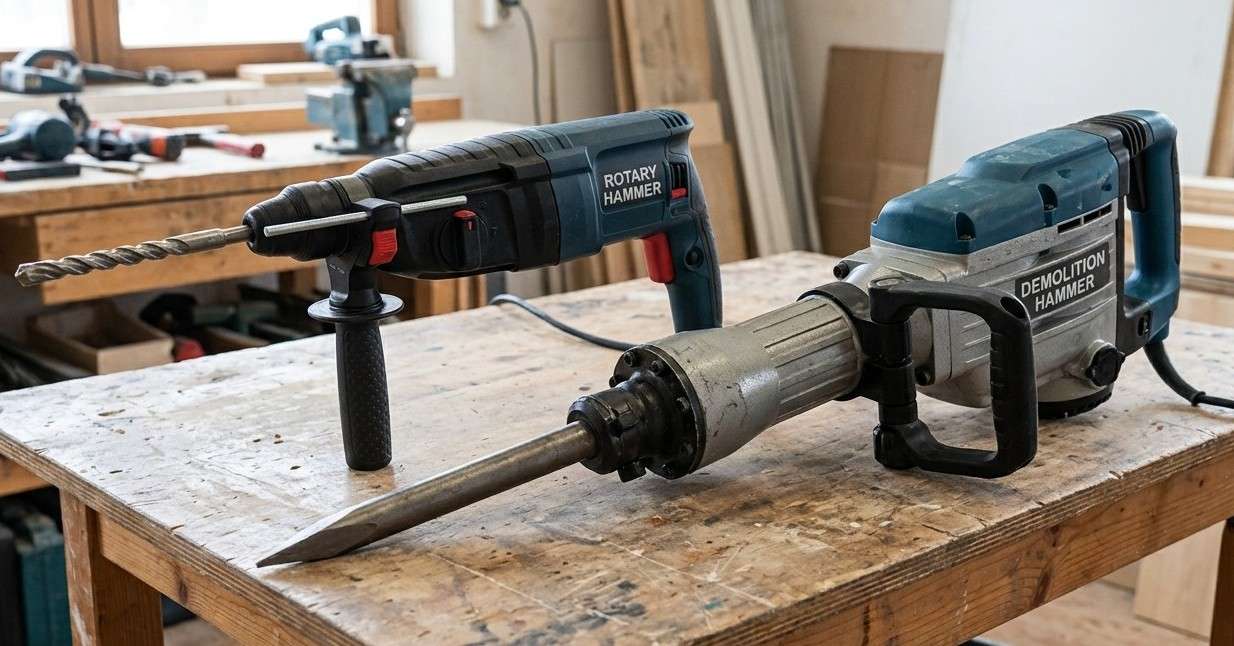
Rotary Hammer vs Demolition Hammer: Which Tool to Use
Use a rotary hammer to drill holes in concrete, masonry, and stone, or for light chiseling, and use a demolition hammer to break, chip, and remove concrete, tile, and asphalt. Rotary hammers favor drilling precision, while demolition hammers favor raw impact energy, so the task decides which tool runs first.
Choosing between a rotary hammer vs demolition hammer looks simple until the wrong tool stalls a crew mid-shift. Rotary and demolition hammers both strike hard materials, yet they solve different problems. This guide explains how each works, where each belongs, and which mistakes cost the most.
What Is the Difference Between a Rotary Hammer and a Demolition Hammer?
A rotary hammer is a heavy-duty power tool designed to drill, hammer, and chisel through hard materials like concrete, brick, masonry, and reinforced stone. A demolition hammer is a heavy-duty power tool used exclusively for breaking, chipping, and chiseling hard materials like concrete, masonry, and tile.
Impact energy marks the clearest dividing line. Rotary hammers typically deliver 1 to 10 joules per blow. Demolition hammers start near 20 joules, and heavy models exceed 60.
Weight follows the same pattern. Most rotary hammers weigh 4 to 9 pounds. Demolition hammers range from roughly 15 to 65 pounds.
- Rotary hammer: drilling, anchor setting, core drilling, light chiseling
- Demolition hammer: slab breaking, wall removal, trenching, tile and floor stripping
How Does a Rotary Hammer Work?
A rotary hammer uses an electropneumatic mechanism. A piston compresses air to strike the back of the bit while the chuck rotates it. This combination of rotation and percussion cuts clean, accurate holes in concrete without the vibration of a heavier tool.
Most rotary hammers use SDS-Plus or SDS-Max bit systems. SDS-Plus suits holes up to about one inch. SDS-Max handles larger diameters and deeper boreholes.
Many models include a mode selector. Drill-only mode works for wood and metal. Hammer-drill mode handles masonry. Chisel-only mode locks bit rotation for light chipping.
How Does a Demolition Hammer Work?
A demolition hammer drives a chisel straight forward with heavy, repeated blows and no rotation. The tool sends most of its weight and motor energy into each strike, which fractures concrete, asphalt, and masonry quickly. Operators guide the tool rather than push it.
Chisel shape matters. Pointed bits start fractures, flat chisels remove material, and spade bits strip tile and thin-set.
Power sources vary by class:
- Corded electric models run continuously for long slab work.
- Battery models add mobility for interior demolition.
- Pneumatic and hydraulic units serve heavy civil and infrastructure work.
Rotary Hammer vs Demolition Hammer: Which Tool Fits Which Job?
Match the tool to the outcome. If the result is a hole, use the rotary hammer. If the result is rubble, use the demolition hammer. Tasks in between, such as chasing channels or removing small sections, depend on volume and material thickness.
Choose a rotary hammer for:
- Drilling anchor holes for bolts, rebar dowels, and threaded rods
- Running conduit and plumbing penetrations through slabs
- Core drilling with the right bit attachment
- Light chiseling of mortar joints and small patches
Choose a demolition hammer for:
- Breaking concrete slabs, footings, and driveways
- Removing masonry walls and brick facing
- Stripping ceramic tile and thick floor adhesives
- Trenching through compacted soil or asphalt
A useful rule of thumb: if the job needs more than a few minutes of continuous chiseling, a rotary hammer is the wrong tool. It will overheat, and the operator will lose efficiency.
Which Demolition Hammers in UAE Suit Local Job Sites?
Demolition hammers in UAE projects must handle dense, heavily reinforced concrete, high ambient heat, and fine dust. Look for models with strong impact energy, thermal protection, and effective vibration damping. Corded units suit long shifts, while battery models fit interior fit-out work.
Dust deserves special attention. Silica-bearing concrete requires water suppression or vacuum extraction during breaking and drilling. Confirm that any tool you choose supports dust-control attachments.
For drilling tasks in the same environment, rotary hammers with SDS-Max chucks handle deep anchor holes in structural slabs and columns.
What Mistakes Cost the Most Time and Money?
The costliest mistake is forcing a rotary hammer to do demolition work. This overheats the motor, wears the piston mechanism, and shortens tool life. Using a demolition hammer for drilling creates the opposite problem: imprecise holes, damaged anchor positions, and wasted material.
Other common errors include:
- Ignoring vibration exposure limits for operators
- Skipping dust control on silica-bearing concrete
- Running dull or mismatched bits that slow progress
- Choosing a tool by price instead of impact energy and duty cycle
OSHA’s silica rule requires dust controls on concrete drilling and breaking jobs. Treat PPE, hearing protection, and vibration limits as part of tool selection.
How Do You Choose Between the Two for a Single Project?
Start with the end result, then check three variables: material thickness, task duration, and access. Thick slabs and long breaking sessions call for a demolition hammer. Precise drilling, anchoring, and light cleanup call for a rotary hammer. Renovation projects usually require both.
Consider total cost, not purchase price alone. Rental suits one-time breaking work. Ownership suits recurring drilling.
A reliable power tools supplier in UAE can help size rotary and demolition hammers to the job, supply compatible bits and chisels, and arrange service support. Contractors who drill daily and demolish occasionally often own rotary hammers and rent a demolition hammer when a project requires it.
Final Recommendation
The rotary hammer vs demolition hammer decision comes down to purpose. Rotary hammers drill accurately and handle light chiseling. Demolition hammers break and remove material at scale. Pairing the right tool with the right task protects equipment, speeds up work, and keeps crews safer.
Get the right hammer for your UAE project
Not sure whether your site needs a rotary hammer, a demolition hammer, or both? Power Blitzz can help. Tell our team about your project, the material, and the working conditions, and we will recommend the right tools, bits, chisels, and quantities, with a clear quote and no guesswork.
Frequently Asked Questions
Can a rotary hammer replace a demolition hammer?
A rotary hammer can handle small chiseling jobs, such as removing a few tiles or cleaning mortar. It cannot replace a demolition hammer for breaking slabs or walls. Lower impact energy and limited duty cycles make sustained demolition inefficient and hard on the tool.
Can a demolition hammer drill holes?
A demolition hammer cannot drill holes in the usual sense because it lacks bit rotation. It only strikes. Some specialized attachments can create rough openings, but accuracy suffers. Use a rotary hammer for anchor holes, conduit runs, and any work requiring precise diameters.
Which tool is better for DIY home projects?
Most home projects benefit from a rotary hammer, since drilling anchors and small holes is more common than breaking slabs. For one-time demolition, such as removing a patio or floor tile, renting a demolition hammer costs less than buying one.

Popular Posts
November 8, 2023
November 14, 2023
November 28, 2023
December 4, 2023
December 13, 2023
Copyright © 2024 – Power Blitzz– All rights reserved.